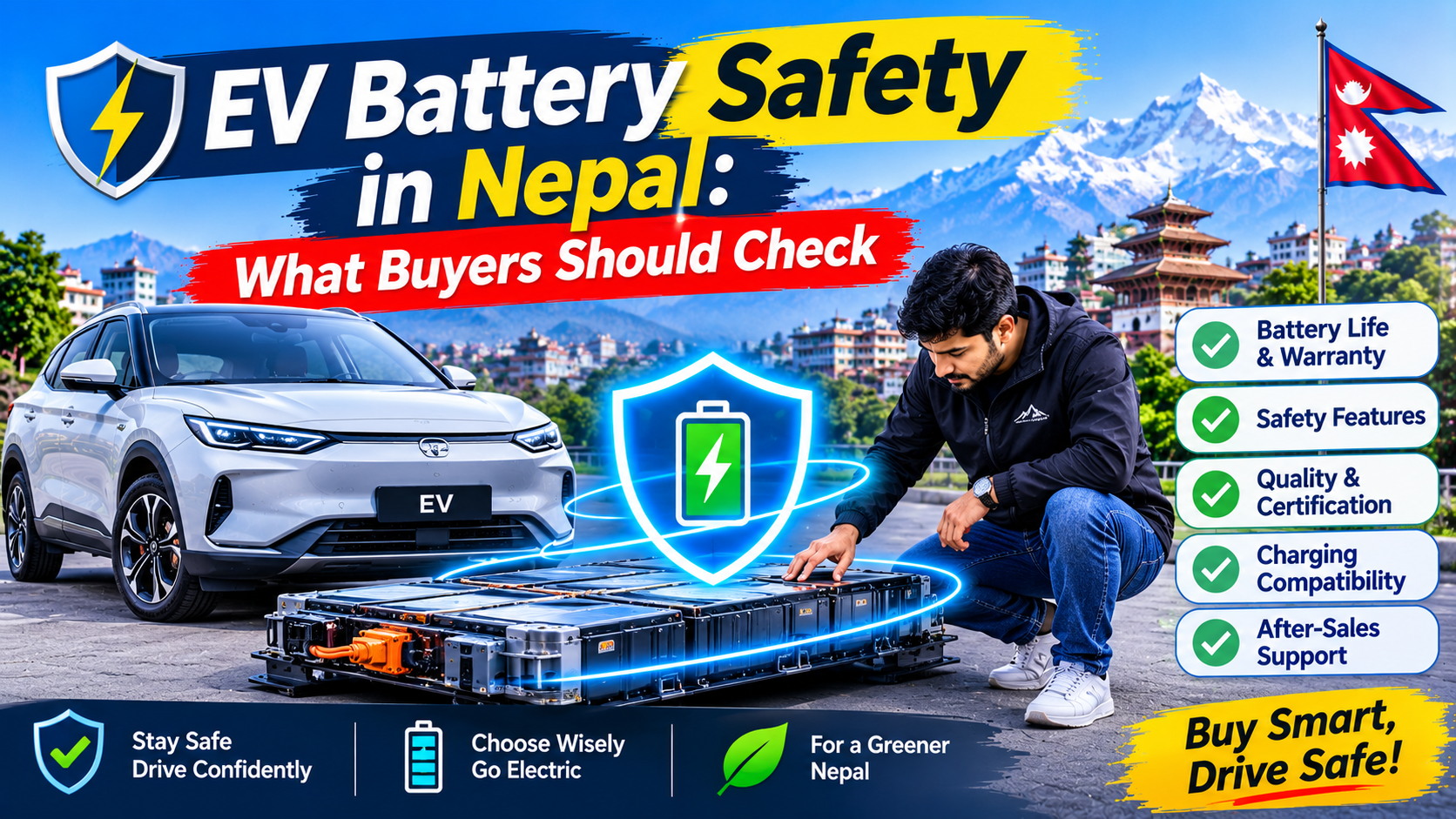
EV fires and weak battery rules are in the news. Check warranty, certification and charging habits before you buy an electric car in Nepal.
On the morning of 11 September 2026, an electric car caught fire while moving on the East-West Highway in Bharatpur, and the driver died. Police are still investigating, and as of 23 November 2026 we could not find a published official cause. The footage spread quickly, though, and many buyers started asking whether EVs are safe. This guide sticks to what has been confirmed, explains where Nepal's rules fall short, and lists what you can check before and after you buy. It draws on reporting from the Kathmandu Post, Meroauto and Clickmandu. Where something is unconfirmed, we say so.
Key takeaways
- The cause of the Bharatpur fire has not been officially established. The importer's early view was that it did not look like a battery fire. A Tribhuvan University engineering professor said a crash beforehand could point to thermal runaway. Both views were given before any investigation result.
- The Kathmandu Post reported on 12 September that no earlier fire in Nepal had been verified as a true traction battery fire. The two earlier high profile cases were traced to a charging cable and to external combustible material.
- US crash data from 2013 to 2017 shows fire in 2 percent of EVs in fatal crashes, against 3.2 percent for petrol cars. That is US data, not Nepal data.
- Nepal has no dedicated way to test whether imported EVs meet international battery safety standards. A draft directive proposes some, and we found no confirmation that it is in force.
- You can still protect yourself. Ask for certificates, get the warranty in writing, check the service network, use proper chargers and learn where your door's mechanical release is.
What we know about the Bharatpur fire
Police said the car caught fire at around 6 am near Basantachowk in Bharatpur Metropolitan City-9. The driver was trapped inside and died. Reports identify the vehicle as a year old GAC Aion Y imported by CG Motors. Footage shows it kept moving while burning, and reports say it later hit a road divider. Police brought in a technical team to help investigate.
The early views differ. CG Motors said its technical team preliminarily suspected this was not a battery fire, because the fire seemed to start at the back of the car while battery fires usually start low, near the chassis. It asked people to wait for the police report and said the manufacturer would inspect the car and make its findings public.
Bishal Silwal, an assistant professor at the Institute of Engineering, Tribhuvan University, said that if the car had crashed first, thermal runaway could have been one of the main causes. He stressed that this was based only on what he had seen. Surendra Kumar Uprety, president of the Nepal Automobile Dealers' Association, said the cause could be a fault in the car, a fault in the charging system or exposure to water, and that a video cannot settle it.
Investigators still need to answer some basic questions, such as whether the doors could be unlocked and why the car was not stopped.
Fires on record in Nepal
The Kathmandu Post found two earlier high profile EV fires. Neither was traced to the battery.
| Date |
Vehicle |
Location |
What investigators found |
| Jan 2024 |
MG EV |
Budhanilkantha, Kathmandu |
Burned overnight while plugged in. The manufacturer found the high voltage battery undamaged and pointed to a short circuit in the charging cable and socket. |
| May 2025 |
BYD Atto 3 |
Pathari, Morang |
Joint inspections found the Blade battery and high voltage powertrain intact. External combustible material near the car was the probable origin. |
| Sep 2026 |
GAC Aion Y |
Bharatpur, Chitwan |
Cause not established. |
Sources: Kathmandu Post explainer (12 September 2026) and Meroauto. Nepal's national fire records have no separate category for EVs, so this table lists documented high profile cases, not a full count.
How common are EV fires?
Counting EV fires worldwide is hard because reporting is patchy. One global tracking repository verified 511 passenger EV traction battery fires between 2010 and June 2024. A bigger fleet will always produce more fires, so researchers compare rates instead of totals.
| Vehicle type |
Share of vehicles in fatal crashes that caught fire |
| Electric |
2.0% |
| Petrol |
3.2% |
US National Transportation Safety Board data on crash related fires, 2013 to 2017. This is not Nepal data.
The risk people worry about most is thermal runaway. Inside each battery cell, a thin separator keeps the two terminals apart. A crash, a manufacturing defect, overcharging or saltwater from flooding can breach it. That sets off a chain reaction of heat that can spread from cell to cell through the pack. Fires can also start elsewhere. The 12 volt wiring, upholstery and tyres can ignite with no battery involved.
Where Nepal's rules fall short
More than 60 countries, including the EU, the UK, Japan and South Korea, require EVs to pass UN Regulation 100 before sale. It covers crash resistance, overcharge protection and fire containment. The Kathmandu Post's editorial says Nepal has no equivalent, and that its regulators admit there is no dedicated mechanism to test imported EVs against any international safety benchmark.
A government task force reported similar gaps in May 2026. It found that Nepal lacks minimum testing standards for imported, assembled and locally produced EVs and chargers, and that virtually any type of EV was entering the market. It also found that Nepal lacks the specialised firefighting tools and emergency systems needed for lithium ion fires, and that testing bodies lack the money and technical capacity for full certification. Nearly 72 percent of roads are unpaved, which matters because battery packs sit under the vehicle floor and can be damaged by rocks and scraping.
Uprety has argued that weak import rules risk turning Nepal into a testing ground for new technology.
The Department of Transport Management has drafted a vehicle import directive. A June 2026 report said implementation had been delayed, and that officials planned road tests and battery and motor approvals for EVs. We found no confirmation that the directive is in force. For EVs, the draft proposes:
| Item |
Proposed condition |
| Battery life |
At least 7 years or 3,000 charge cycles |
| Thermal management |
A working thermal management system |
| Battery safety standard |
UL 2580, IEC 62133 or AIS 049/IS 17017 |
| Ground clearance |
At least 180 mm for cars |
| Range |
At least 300 km on a full charge for cars |
| Paperwork |
Type approval certificate from the manufacturer's home country |
Source: draft vehicle import directive (2082) as reported in June 2025 and June 2026. These are proposals, not confirmed rules.
What to check before you buy
Ask for the battery safety certificate
Ask which battery safety standard the pack meets, such as UN R100, UL 2580, IEC 62133 or AIS 049/IS 17017, and ask to see the document. These are reference points from the editorial and the draft directive, not a legal requirement in Nepal today. Since nobody tests the car for you, a clear answer from the dealer tells you something. A vague one tells you something too.
Get the battery warranty in writing
Terms differ by brand. Our BYD guide lists a 10 year or 200,000 km warranty on the motor and battery for BYD, for example. Ask what counts as battery failure, whether loss of capacity is covered and who handles a claim.
Check the service network and parts
The task force found that some EV models imported into Nepal are discontinued in their home countries within a few years, which leaves owners without parts or support. It also found a shortage of trained EV technicians. Ask how long the model has been sold, where the nearest authorised service centre is and whether its technicians are trained in high voltage systems.
Look at ground clearance and underbody protection
With a floor mounted pack and so many unpaved roads, low cars carry more risk. Check the clearance and ask how the underside of the pack is protected. After any hard scrape or impact, have the underside inspected by the authorised service centre.
Use the right charger and a sound electrical setup
The 2024 MG fire was traced to a short circuit in the charging cable and socket, not the battery. Use only the charger approved by your dealer, replace worn cables and have your home socket and wiring checked by a qualified electrician. The task force also flagged inadequate input power and wiring capacity at some charging stations. For charging costs, see our guide to the NEA EV charging tariff.
Ask how recalls work
Silwal said responsible brands recall vehicles when they find a battery problem, and called a recall a sign the system is working. Ask the dealer how a recall would be handled in Nepal.
What to do as an owner
- Find the mechanical door release. EVs usually lock their doors automatically while moving. Electronic handles run on the 12 volt circuit, which can fail in a crash or fire, so manufacturers fit mechanical releases. Their behaviour varies by model, so check your manual and practise finding it.
- Do not ignore warnings. Uprety said drivers should never treat overheating or battery faults as minor issues.
- Get the car checked after water or impact. Saltwater flooding and crashes can both damage a battery pack.
- Drive smoothly. Silwal said electric motors deliver more torque than the petrol engines Nepali drivers are used to, and that habits carried over from petrol cars have contributed to accidents, especially in electric microbuses.
- If a fire starts, get everyone out and away from the car, then call the fire brigade and tell them it is an EV. Small handheld extinguishers cannot cool a sealed battery pack. Firefighters need large amounts of water, and the fire can restart hours or even days later.
Should buyers worry?
Both experts quoted by the Post said EV fires are real but rare, and that one tragedy does not show EVs are unsafe. Silwal said that if brands meet international compliance standards, there is no particular reason for fear. Uprety said the right response is to investigate the accident and publish what is found. Both want testing against international standards, tighter import rules and safety training for owners and firefighters.
Compare battery size, range and warranty side by side on the GoWithEVs compare page, or check monthly costs with the EMI calculator.
FAQs
Are EVs more likely to catch fire than petrol cars?
Not according to the data we found. US crash data from 2013 to 2017 showed fire in 2 percent of EVs in fatal crashes and 3.2 percent of petrol cars. The Kathmandu Post editorial says EV fire rates are comparable to, and by some measures lower than, petrol vehicles. There is no Nepal specific data, because national records have no EV fire category.
Has a battery fire been confirmed in Nepal?
As of the Kathmandu Post's report on 12 September 2026, no publicly documented incident in Nepal had been verified as a true traction battery fire. The Bharatpur case could be the first if a battery fault is confirmed. We could not find a published result.
What caused the Bharatpur fire?
It was not established as of 23 November 2026. Police are investigating with technical help, and CG Motors said the manufacturer will inspect the car and publish its report.
Does Nepal require EV battery safety certification?
There is no dedicated mechanism to test imported EVs against international battery standards, according to the Kathmandu Post editorial and a government task force. A draft import directive proposes battery standards, and we found no confirmation that it is in force.
Is an LFP battery safer?
Meroauto reported that the Aion Y uses a lithium iron phosphate (LFP) battery, a chemistry considered among the most thermally stable. It added that this does not mean such batteries can never catch fire. Ask your dealer which chemistry a model uses, and still ask for the safety certificate.
Sources
- Kathmandu Post, Explainer: Why and how EVs catch fire, 12 September 2026
- Kathmandu Post, Nepal fell in love with EVs. It forgot to regulate them, 14 September 2026
- Kathmandu Post, Man dies after electric car catches fire in Bharatpur, 11 September 2026
- Meroauto, CG Motors responds to fatal Aion Y fire incident in Bharatpur, 15 September 2026
- Meroauto, Chitwan accident: why did the car keep moving even as it was engulfed in flames?, 12 September 2026
- Clickmandu, Nepal's roads deemed unsafe for EVs as government study flags deep structural gaps, 1 May 2026
- Peoples' Review, Is Nepal becoming a dumping ground for EVs?, 8 June 2026
- The Nepal Weekly, Directives for import of automobile in the offing, 26 June 2025